
Tag: CD rates

  • Can CD Rates Change After Purchase

    Can CD Rates Change After Purchase

    Can CD Rates Change After Purchase? Certificates of Deposit (CDs) are a popular savings tool offering higher interest rates than regular savings accounts. One common question is whether CD rates can change after purchasing them. Typically, no, CD rates do not change after purchase. This is because CDs are fixed-rate investments, meaning the interest rate you lock in at the time of purchase remains the same for the entire term of the CD.  

    Can CD Rates Change After Purchase

    However, there are a few exceptions to this rule. Some banks offer variable-rate CDs, where the interest rate can fluctuate based on market conditions. Additionally, certain types of CDs, such as bump-up CDs, allow you to increase the interest rate once or twice during the term, often for a fee.

    Can CD Rates Change After Purchase?

    Can CD Rates Change After Purchase? No, generally, CD rates are locked in at the time of purchase. This means that once you’ve opened a CD, the interest rate you’ll earn for the entire term of the CD remains fixed. This provides a degree of certainty and stability for your savings.

    Exceptions to the Rule: Variable Rate CDs

    While most CDs have fixed rates, there’s a specific type called variable rate CDs. As the name suggests, the interest rate on these CDs can fluctuate over time. This means that the interest you earn could increase or decrease depending on market conditions.

    Why CD Rates Don’t Change After Purchase

    The fixed nature of CD rates is a core feature that attracts investors. This stability provides predictability and allows for financial planning. Here’s why CD rates remain unchanged:

    • Contractual Agreement: When you purchase a CD, you’re entering into a contract with the financial institution. This contract outlines the terms, including the interest rate, which is agreed upon upfront.
    • Market Fluctuations: While interest rates in the broader market may fluctuate, your CD’s rate is locked in. This protects you from potential interest rate hikes or declines.
    • Risk Mitigation: The fixed rate helps mitigate the risk associated with interest rate changes. Investors can confidently invest for a specific period without worrying about their returns being affected by market fluctuations.

    Factors Influencing CD Rates

    Several factors influence the interest rates offered on Certificates of Deposit (CDs). These include:

    • Federal Reserve Interest Rates: The Federal Reserve’s monetary policy plays a significant role in determining CD rates. When the Fed raises interest rates, it generally leads to higher CD rates as banks offer more competitive returns to attract deposits. Conversely, lower Fed rates often result in lower CD rates.
    • Economic Conditions: The overall economic climate also affects CD rates. During periods of economic growth, banks may be more willing to offer higher rates to attract deposits. However, during economic downturns, they may lower rates to conserve capital.
    • Bank Competition: Competition among banks can significantly impact CD rates. Banks may offer higher rates to attract customers and differentiate themselves from competitors.
    • Term Length: The length of the CD term can influence the interest rate. Longer-term CDs typically offer higher rates to compensate investors for locking up their money for a longer period.
    • Bank Size and Reputation: Larger, more established banks may offer slightly lower rates due to their lower risk profile. However, smaller banks or online banks may offer higher rates to compete for customers.
    • Special Promotions: Banks may offer limited-time promotions or bonuses to attract new customers or increase deposits. These promotions can result in higher CD rates.

    It’s important to note that CD rates can fluctuate over time, so it’s advisable to shop around and compare offers from different banks to find the best rate for your needs.

    Choosing the Right CD

    When selecting a CD, it’s crucial to consider the following factors:

    • Term: The term of the CD determines how long your money will be locked up. Longer terms often offer higher interest rates, but also carry a higher risk of early withdrawal penalties.
    • Interest Rate: Compare rates from different banks and credit unions to find the best deal. Keep in mind that higher rates often come with longer terms or more restrictive conditions.
    • Compounding Frequency: The frequency at which interest is compounded can impact your overall return. Daily compounding generally yields slightly higher returns than monthly or quarterly compounding.
    • Minimum Deposit: Some CDs have minimum deposit requirements, so be sure to check before investing.

    Frequently Asked Questions (FAQs)

    Can a bank change the CD rate after I’ve opened it?

    No, generally, banks cannot change the CD rate after it’s been purchased. The rate is fixed for the term.

    What happens if interest rates rise after I purchase a CD?

    If interest rates rise after you’ve purchased a CD, you won’t benefit from the higher rates. However, your initial rate remains fixed.

    Can I withdraw my funds from a CD early without penalty?

    Typically, withdrawing funds early from a CD incurs a penalty. The penalty can vary depending on the financial institution and the term of the CD.

    Are there any exceptions to the fixed rate rule for CDs?

    While rare, there may be specific types of CDs, such as variable rate CDs, that have rates that can fluctuate. However, these are not as common as fixed-rate CDs.

    Is it better to lock in a CD rate or wait for interest rates to rise?

    The decision of whether to lock in a CD rate depends on your individual financial goals and risk tolerance. If you’re confident that interest rates will rise significantly, it might make sense to wait. However, if you prefer stability and predictability, locking in a CD rate can be advantageous.

    Conclusion

    CDs offer a relatively safe and predictable investment option with fixed interest rates. While market conditions can influence the overall attractiveness of CDs, the rate you lock in at the time of purchase remains unchanged throughout the term. By carefully considering factors like term, interest rate, compounding frequency, and early withdrawal penalties, you can choose a CD that aligns with your financial goals and risk tolerance.

  • Edward Jones CD Rates – Competitive Interest Rates

    Edward Jones CD Rates – Competitive Interest Rates

    Edward Jones, a well-respected investment firm, offers a variety of financial products, including Certificates of Deposit (CDs). CDs are popular savings vehicles known for their stability and competitive interest rates. This guide will delve into the intricacies of Edward Jones CD rates, providing valuable insights for investors seeking to grow their savings.

    Edward Jones CD Rates

    We will explore the factors that influence Edward Jones CD rates, such as term lengths, deposit amounts, and market conditions. Additionally, we will discuss the benefits of investing in Edward Jones CDs, including guaranteed returns, FDIC insurance, and the potential for compounding interest. By the end of this guide, you will have a solid understanding of Edward Jones CD rates and be equipped to make informed decisions about your investment strategy.

    Understanding Edward Jones CD Rates

    Edward Jones CDs are a secure way to grow your savings. They offer fixed interest rates, meaning you’ll know exactly how much interest you’ll earn over a specific term. This predictability makes them a great choice for those seeking a low-risk investment option.

    Current Edward Jones CD Rates

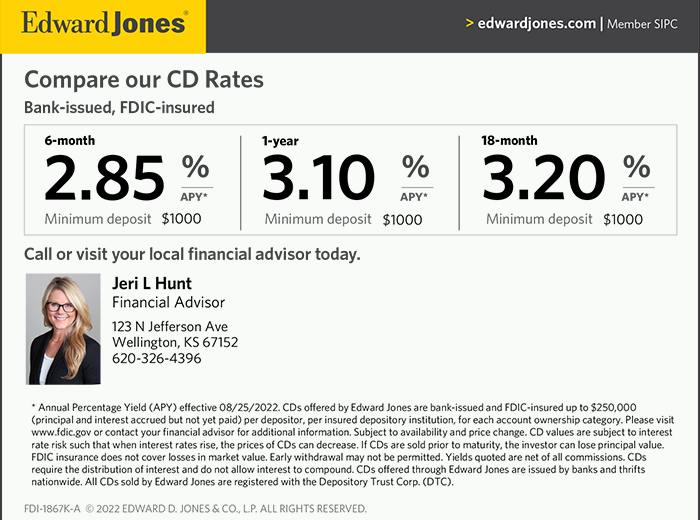
    According to reports, Edward Jones CD rates are quite higher than the national average CD rates and some terms are quite competitive with the best CD rates. Here is a table that shows the Edward Jones CD rates:

    TermAnnual Percentage Yield
    3 months4.95%
    6 months4.65%
    9 months4.45%
    1 year4.25%
    18 months4.10%
    2 years4.00%
    30 months3.900%
    3 years3.85%
    4 years3.80%
    5 years3.75%
    7 yearsN/A
    10 yearsN/A

    However, for the most accurate and up-to-date information, I recommend visiting the Edward Jones website or contacting your financial advisor directly. CD rates can fluctuate based on market conditions, so it’s essential to get the latest information before making a decision.  

    You can find the current CD rates on the Edward Jones website: https://www.edwardjones.com/us-en/market-news-insights/stock-market-news/current-rates.

    Factors That Influence Edward Jones CD Rates

    Several factors can influence the CD rates offered by Edward Jones:

    • Federal Reserve Interest Rate: The Federal Reserve’s monetary policy plays a significant role in determining interest rates across the economy. When the Federal Reserve raises interest rates, it generally leads to higher CD rates, and vice versa.
    • Market Conditions: Economic conditions, such as inflation and investor sentiment, can also impact CD rates. During times of economic uncertainty, investors may be more likely to seek the safety and stability of CDs, which can drive up demand and potentially increase rates.
    • CD Term: The length of the CD term can influence the interest rate. Longer-term CDs typically offer higher interest rates to compensate investors for locking up their funds for a longer period.
    • Amount of Investment: In some cases, the amount of money invested in a CD can affect the interest rate. Larger deposits may be eligible for higher rates.
    • Individual Circumstances: Your specific financial situation and goals can also influence the CD rate you receive. Factors such as your credit history and relationship with Edward Jones may be considered when determining rates.

    It’s important to note that CD rates can fluctuate over time, and it’s advisable to consult with a financial advisor to get the most accurate and up-to-date information on current rates and to discuss which CD best aligns with your financial objectives.

    Edward Jones CD Pros and Cons

    Pros

    • Reputation and Stability: Edward Jones is a well-established financial firm with a strong reputation for reliability and customer service.
    • Wide Range of Options: They offer a variety of CD terms and interest rates to cater to different financial needs and risk tolerances.
    • Accessibility: CDs are generally easy to open and manage, making them accessible to investors of all levels.
    • Guaranteed Returns: CDs provide guaranteed returns, making them a relatively low-risk investment option.
    • FDIC Insurance: CDs issued by Edward Jones are typically FDIC-insured, providing protection against the loss of your principal investment up to the insured limit.

    Cons

    • Lower Interest Rates Compared to Other Investments: While CDs offer guaranteed returns, their interest rates may be lower than those of other investment options, such as stocks or bonds, especially in periods of economic growth.
    • Liquidity Restrictions: CDs often have early withdrawal penalties, which can limit your access to your funds if you need to withdraw them before maturity.
    • Inflation Risk: If inflation outpaces the interest rate on your CD, the purchasing power of your investment may decline over time.

    Should You Invest in Edward Jones CDs?

    Whether or not you should invest in Edward Jones CDs depends on your individual financial goals and risk tolerance. CDs can be a good option for those seeking a relatively safe and stable investment with guaranteed returns. However, they also have limitations, such as early withdrawal penalties and potential for lower returns compared to other investment options.

    How to Invest in Edward Jones CDs

    Investing in Edward Jones CDs: A Step-by-Step Guide

    1. Open an Account: The first step is to open an investment account with Edward Jones. You can do this by contacting a financial advisor or visiting a nearby Edward Jones office.
    2. Consult with a Financial Advisor: A financial advisor can help you assess your financial goals and risk tolerance to determine if a CD is a suitable investment for you. They can also provide information about the available CD options and their terms.
    3. Choose a CD: Based on your financial goals and the advice from your advisor, select a CD that meets your needs. Consider factors such as the term, interest rate, and any minimum investment requirements.
    4. Make a Deposit: Once you’ve chosen a CD, make the required deposit to your Edward Jones account. The deposit amount will depend on the specific CD you’ve selected.
    5. Monitor Your Investment: Keep track of your CD investment and its performance. You can access your account information online or through your Edward Jones advisor.

    Edward Jones CD Rates to Other Banks

    When considering CDs from Edward Jones, it’s important to compare their rates to those offered by other financial institutions. You can use online tools or visit multiple banks to gather information and make an informed decision.

    Factors to consider when comparing rates include:

    • Interest Rate: The annual percentage yield (APY) offered by the CD.
    • Fees: Some banks may charge fees for early withdrawal or other services.
    • Minimum Deposit: The required initial investment.
    • Customer Service: The quality of support provided by the bank.

    Frequently Asked Questions

    Are Edward Jones CD rates competitive?

    Edward Jones CD rates are generally competitive with other banks and financial institutions. However, it’s always a good idea to compare rates to ensure you’re getting the best deal.

    Can I withdraw my money early from an Edward Jones CD?

    Early withdrawal from a CD may result in penalties. The specific terms and conditions for early withdrawal will vary depending on the CD.

    How often are interest payments made on Edward Jones CDs?

    Interest payments on Edward Jones CDs are typically made monthly, quarterly, or annually. The frequency of payments will be specified when you open the CD.

    Are Edward Jones CDs insured?

    Yes, Edward Jones CDs are insured by the Securities Investor Protection Corporation (SIPC) for up to $500,000 per account, including $250,000 for cash.

    How do I open an Edward Jones CD?

    To open an Edward Jones CD, you’ll typically need to contact a financial advisor. They can help you choose the right CD based on your investment goals and risk tolerance.

    How do Edward Jones CD rates compare to other banks?

    Edward Jones CD rates can be competitive, but it’s always a good idea to compare rates from multiple financial institutions.

    Can I reinvest the interest earned on my CD?

    Yes, you can often reinvest the interest earned on your CD to increase your overall return.

    Are there any fees associated with Edward Jones CDs?

    There may be fees associated with opening or closing a CD. It’s important to understand any fees before investing.

    What is the minimum deposit for an Edward Jones CD?

    The minimum deposit for an Edward Jones CD may vary depending on the specific CD product.

    How often are interest payments made on Edward Jones CDs?

    Interest payments on Edward Jones CDs are typically made on a quarterly or monthly basis.

    What is the minimum term for an Edward Jones CD?

    The minimum term for an Edward Jones CD may vary, but it’s typically at least three months.

    Can I ladder my Edward Jones CDs?

    Yes, you can ladder your Edward Jones CDs by investing in CDs with different terms. This can help you manage your liquidity and risk.

    Conclusion

    Edward Jones CD rates offer a competitive savings option for individuals looking for a guaranteed return on their investment. By understanding the factors that influence rates, comparing options, and considering your individual financial goals, you can make an informed decision about whether an Edward Jones CD is right for you.