
Tag: Investment

  • Edward Jones CD Rates – Competitive Interest Rates

    Edward Jones CD Rates – Competitive Interest Rates

    Edward Jones, a well-respected investment firm, offers a variety of financial products, including Certificates of Deposit (CDs). CDs are popular savings vehicles known for their stability and competitive interest rates. This guide will delve into the intricacies of Edward Jones CD rates, providing valuable insights for investors seeking to grow their savings.

    Edward Jones CD Rates

    We will explore the factors that influence Edward Jones CD rates, such as term lengths, deposit amounts, and market conditions. Additionally, we will discuss the benefits of investing in Edward Jones CDs, including guaranteed returns, FDIC insurance, and the potential for compounding interest. By the end of this guide, you will have a solid understanding of Edward Jones CD rates and be equipped to make informed decisions about your investment strategy.

    Understanding Edward Jones CD Rates

    Edward Jones CDs are a secure way to grow your savings. They offer fixed interest rates, meaning you’ll know exactly how much interest you’ll earn over a specific term. This predictability makes them a great choice for those seeking a low-risk investment option.

    Current Edward Jones CD Rates

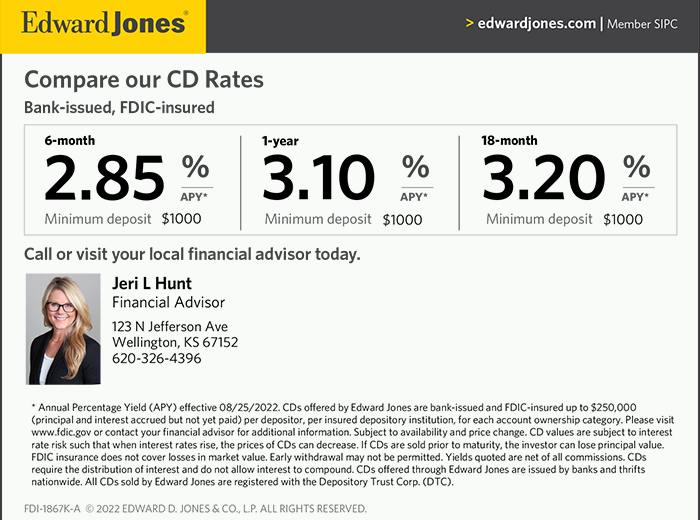
    According to reports, Edward Jones CD rates are quite higher than the national average CD rates and some terms are quite competitive with the best CD rates. Here is a table that shows the Edward Jones CD rates:

    TermAnnual Percentage Yield
    3 months4.95%
    6 months4.65%
    9 months4.45%
    1 year4.25%
    18 months4.10%
    2 years4.00%
    30 months3.900%
    3 years3.85%
    4 years3.80%
    5 years3.75%
    7 yearsN/A
    10 yearsN/A

    However, for the most accurate and up-to-date information, I recommend visiting the Edward Jones website or contacting your financial advisor directly. CD rates can fluctuate based on market conditions, so it’s essential to get the latest information before making a decision.  

    You can find the current CD rates on the Edward Jones website: https://www.edwardjones.com/us-en/market-news-insights/stock-market-news/current-rates.

    Factors That Influence Edward Jones CD Rates

    Several factors can influence the CD rates offered by Edward Jones:

    • Federal Reserve Interest Rate: The Federal Reserve’s monetary policy plays a significant role in determining interest rates across the economy. When the Federal Reserve raises interest rates, it generally leads to higher CD rates, and vice versa.
    • Market Conditions: Economic conditions, such as inflation and investor sentiment, can also impact CD rates. During times of economic uncertainty, investors may be more likely to seek the safety and stability of CDs, which can drive up demand and potentially increase rates.
    • CD Term: The length of the CD term can influence the interest rate. Longer-term CDs typically offer higher interest rates to compensate investors for locking up their funds for a longer period.
    • Amount of Investment: In some cases, the amount of money invested in a CD can affect the interest rate. Larger deposits may be eligible for higher rates.
    • Individual Circumstances: Your specific financial situation and goals can also influence the CD rate you receive. Factors such as your credit history and relationship with Edward Jones may be considered when determining rates.

    It’s important to note that CD rates can fluctuate over time, and it’s advisable to consult with a financial advisor to get the most accurate and up-to-date information on current rates and to discuss which CD best aligns with your financial objectives.

    Edward Jones CD Pros and Cons

    Pros

    • Reputation and Stability: Edward Jones is a well-established financial firm with a strong reputation for reliability and customer service.
    • Wide Range of Options: They offer a variety of CD terms and interest rates to cater to different financial needs and risk tolerances.
    • Accessibility: CDs are generally easy to open and manage, making them accessible to investors of all levels.
    • Guaranteed Returns: CDs provide guaranteed returns, making them a relatively low-risk investment option.
    • FDIC Insurance: CDs issued by Edward Jones are typically FDIC-insured, providing protection against the loss of your principal investment up to the insured limit.

    Cons

    • Lower Interest Rates Compared to Other Investments: While CDs offer guaranteed returns, their interest rates may be lower than those of other investment options, such as stocks or bonds, especially in periods of economic growth.
    • Liquidity Restrictions: CDs often have early withdrawal penalties, which can limit your access to your funds if you need to withdraw them before maturity.
    • Inflation Risk: If inflation outpaces the interest rate on your CD, the purchasing power of your investment may decline over time.

    Should You Invest in Edward Jones CDs?

    Whether or not you should invest in Edward Jones CDs depends on your individual financial goals and risk tolerance. CDs can be a good option for those seeking a relatively safe and stable investment with guaranteed returns. However, they also have limitations, such as early withdrawal penalties and potential for lower returns compared to other investment options.

    How to Invest in Edward Jones CDs

    Investing in Edward Jones CDs: A Step-by-Step Guide

    1. Open an Account: The first step is to open an investment account with Edward Jones. You can do this by contacting a financial advisor or visiting a nearby Edward Jones office.
    2. Consult with a Financial Advisor: A financial advisor can help you assess your financial goals and risk tolerance to determine if a CD is a suitable investment for you. They can also provide information about the available CD options and their terms.
    3. Choose a CD: Based on your financial goals and the advice from your advisor, select a CD that meets your needs. Consider factors such as the term, interest rate, and any minimum investment requirements.
    4. Make a Deposit: Once you’ve chosen a CD, make the required deposit to your Edward Jones account. The deposit amount will depend on the specific CD you’ve selected.
    5. Monitor Your Investment: Keep track of your CD investment and its performance. You can access your account information online or through your Edward Jones advisor.

    Edward Jones CD Rates to Other Banks

    When considering CDs from Edward Jones, it’s important to compare their rates to those offered by other financial institutions. You can use online tools or visit multiple banks to gather information and make an informed decision.

    Factors to consider when comparing rates include:

    • Interest Rate: The annual percentage yield (APY) offered by the CD.
    • Fees: Some banks may charge fees for early withdrawal or other services.
    • Minimum Deposit: The required initial investment.
    • Customer Service: The quality of support provided by the bank.

    Frequently Asked Questions

    Are Edward Jones CD rates competitive?

    Edward Jones CD rates are generally competitive with other banks and financial institutions. However, it’s always a good idea to compare rates to ensure you’re getting the best deal.

    Can I withdraw my money early from an Edward Jones CD?

    Early withdrawal from a CD may result in penalties. The specific terms and conditions for early withdrawal will vary depending on the CD.

    How often are interest payments made on Edward Jones CDs?

    Interest payments on Edward Jones CDs are typically made monthly, quarterly, or annually. The frequency of payments will be specified when you open the CD.

    Are Edward Jones CDs insured?

    Yes, Edward Jones CDs are insured by the Securities Investor Protection Corporation (SIPC) for up to $500,000 per account, including $250,000 for cash.

    How do I open an Edward Jones CD?

    To open an Edward Jones CD, you’ll typically need to contact a financial advisor. They can help you choose the right CD based on your investment goals and risk tolerance.

    How do Edward Jones CD rates compare to other banks?

    Edward Jones CD rates can be competitive, but it’s always a good idea to compare rates from multiple financial institutions.

    Can I reinvest the interest earned on my CD?

    Yes, you can often reinvest the interest earned on your CD to increase your overall return.

    Are there any fees associated with Edward Jones CDs?

    There may be fees associated with opening or closing a CD. It’s important to understand any fees before investing.

    What is the minimum deposit for an Edward Jones CD?

    The minimum deposit for an Edward Jones CD may vary depending on the specific CD product.

    How often are interest payments made on Edward Jones CDs?

    Interest payments on Edward Jones CDs are typically made on a quarterly or monthly basis.

    What is the minimum term for an Edward Jones CD?

    The minimum term for an Edward Jones CD may vary, but it’s typically at least three months.

    Can I ladder my Edward Jones CDs?

    Yes, you can ladder your Edward Jones CDs by investing in CDs with different terms. This can help you manage your liquidity and risk.

    Conclusion

    Edward Jones CD rates offer a competitive savings option for individuals looking for a guaranteed return on their investment. By understanding the factors that influence rates, comparing options, and considering your individual financial goals, you can make an informed decision about whether an Edward Jones CD is right for you.

  • Hard Money vs Traditional Lenders: Which is Right for You?

    Hard Money vs Traditional Lenders: Which is Right for You?

    Hard Money vs Traditional Lenders. Financing real estate endeavors can be a complex decision, especially when navigating the different options available. Understanding the key differences between hard money lenders and traditional lenders is crucial for making informed choices and selecting the most suitable option for your specific situation.

    Hard Money vs Traditional Lenders

    This comprehensive guide dives deep into the intricacies of both types of lenders, comparing their loan approval processes, interest rates, loan terms, eligibility requirements, and more. By the end, you’ll be equipped with the knowledge to confidently choose the right financing partner to achieve your real estate goals.

    What Hard Money vs Traditional Lenders

    Hard Money

    This is the most common use of the term. It refers to a short-term, asset-based loan, typically used in real estate transactions. These loans are secured by real property, meaning the borrower uses a property as collateral for the loan. Hard money loans are often used by real estate investors, such as house flippers, who need to finance the purchase and renovation of a property quickly. They are also used by individuals who have been denied a traditional mortgage or who need to close on a property quickly.

    Traditional Lenders

    Traditional lenders are established financial institutions that have been offering loan products for many years. These institutions typically have a physical presence, such as branches, and a long history of operating within the financial system.

    Hard Money Loans vs Traditional Lenders: A Breakdown

    Loan Approval Process

    Hard Money: Known for their faster and more streamlined approval process, hard money lenders typically focus on the property’s value as collateral rather than the borrower’s credit score. This makes them ideal for individuals with imperfect credit or those seeking funding quickly for time-sensitive opportunities like fix-and-flip projects.

    Traditional Lenders: The approval process for conventional mortgages with institutions like banks or credit unions is generally more rigorous and time-consuming. They extensively evaluate the borrower’s financial history, including income, credit score, and employment stability.

    Interest Rates and Loan Terms

    Hard Money: Due to their higher risk tolerance and shorter loan terms (typically 1-3 years), hard money loans come with significantly higher interest rates compared to traditional mortgages.

    Traditional Lenders: Conventional mortgages offer lower interest rates and longer loan terms (typically 15-30 years), making them more suitable for long-term investments and primary residences.

    Loan-to-Value Ratio (LTV) Requirements

    Hard Money: Lenders typically offer lower LTV ratios (60-70%), meaning borrowers need to bring a larger down payment upfront. This is because hard money caters to riskier projects and distressed properties.

    Traditional Lenders: Conventional mortgages usually offer higher LTV ratios (up to 80% or more), depending on the loan type and borrower qualifications. This allows for a smaller down payment, making homeownership more accessible.

    Property Types Financed

    Hard Money: Often caters to non-owner-occupied properties such as investment properties, fix-and-flip projects, and commercial buildings. These lenders may be more flexible in considering properties requiring renovations or in need of specific work.

    Traditional Lenders: Primarily focus on financing primary residences and may have stricter requirements regarding the property’s condition and occupancy status.

    Eligibility Requirements:

    Hard Money: Eligibility criteria for hard money loans are often less stringent compared to traditional mortgages. While credit score and income may be considered, the primary focus lies on the experience and expertise of the borrower and the potential of the property.

    Traditional Lenders: Qualifying for a conventional mortgage generally requires a strong credit score (typically above 670), a stable employment history, and a demonstrated ability to repay the loan.

    Advantages and Disadvantages

    Hard Money

    Advantages:

    • Fast approvals for time-sensitive projects
    • Flexible financing for non-traditional properties
    • Less stringent eligibility requirements for individuals with lower credit scores

    Disadvantages:

    • Higher interest rates can significantly impact profitability
    • Shorter loan terms necessitate quicker exits from investments
    • Higher down payments required

    Traditional Lenders:

    Advantages:

    • Lower interest rates can lead to higher returns on investment
    • Longer loan terms allow for more flexible exit strategies
    • Potentially lower down payments through higher LTV options

    Disadvantages:

    • Lengthy approval process can delay investment timelines
    • Strict eligibility requirements can exclude some borrowers with lower credit scores
    • Limited flexibility in financing certain property types

    Choosing the Right Lender: Consider Your Needs

    Hard money loans might be a suitable option for:

    • Investors looking for quick funding for fix-and-flip projects or short-term investments.
    • Individuals with imperfect credit who face challenges securing traditional financing.
    • Situations requiring flexible financing for distressed properties needing renovations.

    Traditional lenders are a better fit for:

    • Primary residence purchases where long-term ownership and lower monthly payments are desired.
    • Individuals with strong credit history and stable income seeking the most favorable interest rates.
    • Situations where larger LTV ratios and longer loan terms are crucial for making the purchase accessible.

    FAQs

    When should I consider a hard money lender?

    Hard money lenders are a good option if:

    • You need fast approval for a time-sensitive deal.
    • You are looking to finance a distressed property or a fix-and-flip project.
    • You have a lower credit score or non-traditional income sources that might not qualify you for a traditional loan.
    • You are an experienced investor with a clear exit strategy for the property.

    When is a traditional lender the better choice?

    Traditional lenders are a good option if:

    • You are buying a primary residence.
    • You have good credit and stable income.
    • You prefer lower interest rates and longer repayment terms.
    • You want to finance a larger portion of the property with a smaller down payment.

    What are the typical fees associated with hard money loans?

    In addition to the higher interest rates, hard money loans often involve additional fees such as:

    • Origination fees: Usually a percentage of the loan amount.
    • Processing fees: Cover administrative costs associated with processing the loan.
    • Appraisal fees: May be required even though the primary focus is on the property’s value and potential.
    • Exit fees: Charged for paying off the loan early, which is not always allowed with hard money loans.

    How can I improve my chances of getting approved for a hard money loan?

    • Have a solid business plan: Demonstrate your experience, exit strategy, and projected timeline for the property.
    • Offer a larger down payment: This reduces risk for the lender and increases your chances of approval.
    • Assemble required documentation: This may include tax returns, proof of income, and property information.
    • Be transparent and upfront: Clearly communicate your financial situation, goals, and experience with the lender.

    What are the risks associated with hard money loans?

    • Higher borrowing costs: Due to high interest rates and additional fees, the total cost of the loan can be significantly higher.
    • Shorter loan terms: Increased pressure to sell or refinance the property within a short timeframe can create a sense of urgency.
    • Stricter foreclosure timelines: Hard money lenders may have shorter timelines for foreclosure compared to traditional lenders.

    Conclusion

    Understanding the distinct characteristics of hard money and traditional lenders empowers you to make informed financial decisions. By carefully assessing your specific needs, project goals, and financial situation, you can choose the financing option that best positions you for success in your real estate endeavors.